또 다른 여름의 꿈Dream of Another Summer
감독 이레네 바르톨로메Irene BARTOLOMÉ | Spain, Lebanon | 2026 | 70 min | Documentary | 국제경쟁International Competition
There is a school of thought in environmental psychology, often gathered under the umbrella of psychoarchitecture, that holds that built space is not a neutral backdrop to human experience but an active participant in it. The proportions of a ceiling, the texture of a wall, the angle at which light falls through a window: these are not merely aesthetic conditions but psychological ones. They shape attention, regulate emotion, and determine whether the body feels safe or exposed, held or abandoned. Irene Bartolomé’s debut feature, Dream of Another Summer, unfolds as though it has fully absorbed this premise, not as an abstract theory but as a lived and sensorial truth.
The film follows Alicia, who returns to Beirut sometime after the catastrophic port explosion of August 2020. Yet Bartolomé resists any direct engagement with the event itself and sidesteps the conventions of both reportage and the familiar arc of a homecoming narrative. What draws her attention instead is more elusive: the emotional residue that lingers when both inner and outer worlds have been fractured. Spaces such as kitchens, bedrooms, and cafés continue to hold the imprint of lives once lived within them. The film asks, with quiet insistence, what remains when the visible structures of life have been shattered, and how these remnants continue to speak.
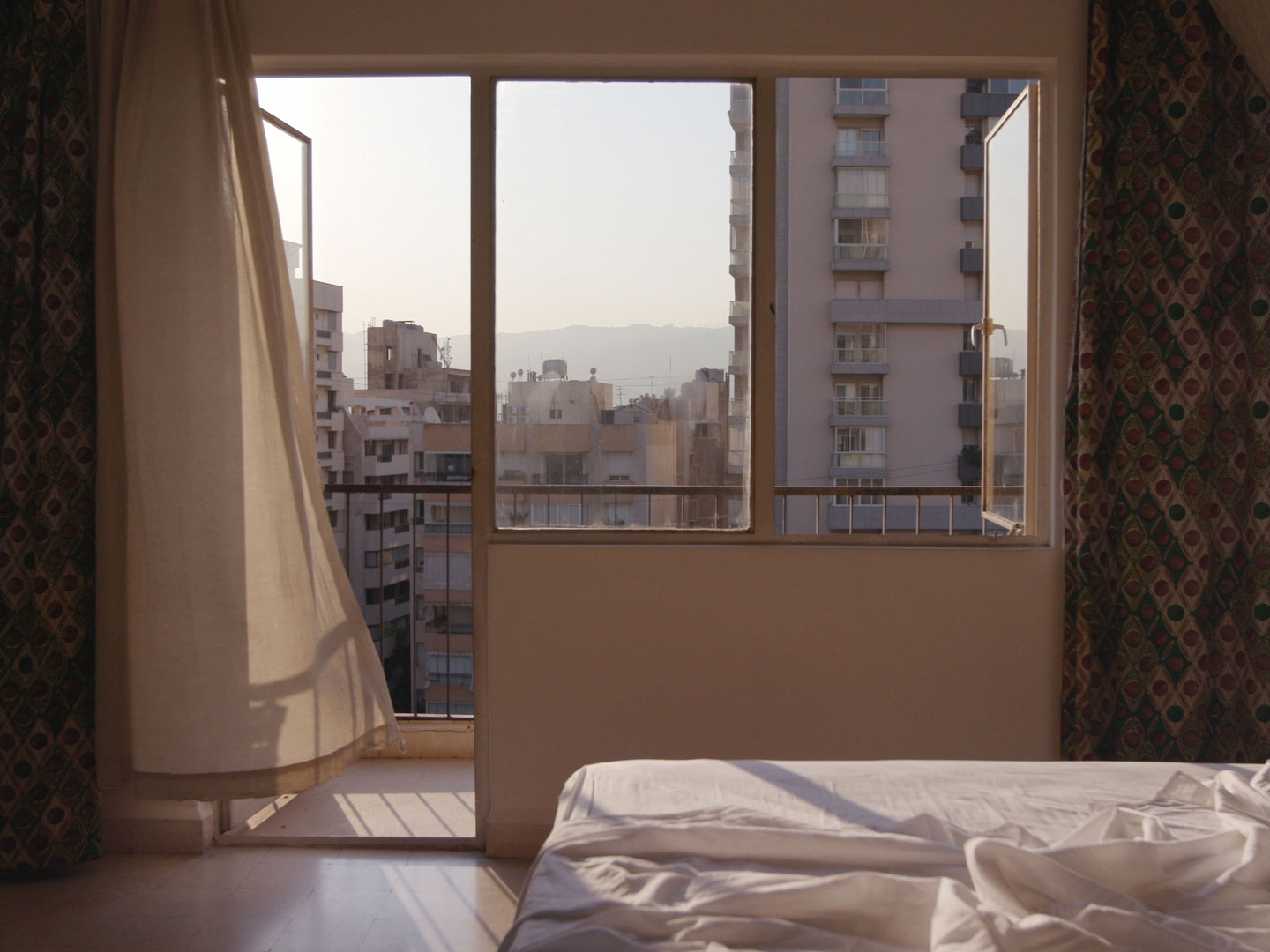
The result is a work of remarkable delicacy and restraint. Dream of Another Summer approaches something akin to phenomenology, an attempt to render not events but the texture of experience itself. Grief, longing, and disorientation are not narrated so much as inscribed onto surfaces, atmospheres, and spatial arrangements. The camera lingers in stillness, transforming a room with an unmade bed into a simple yet devastating articulation of absence. These gestures align Bartolomé with a lineage of rigorous, contemplative cinema, often associated with Chantal Akerman. Yet her register remains distinctly her own. There is a particular tenderness in the way her frames hold the city, as though handling something fragile, aware that even the slightest pressure might cause it to fracture further. The film moves with patience, with stillness, and with a meditative clarity that resists urgency.
Voice messages thread through the film, not as explanatory devices but as fragments of connection. They do not contextualize what we see; rather, they reach outward, searching for something that may no longer be present. Words fall onto spaces the way light does, unevenly and partially illuminating while leaving other areas in shadow. Bartolomé demonstrates a profound sensitivity to the relationship between language and place, to the way certain phrases seem to belong to particular rooms, and to the vertiginous sensation that arises when familiar words echo back from altered environments. Language, here, is not stable but contingent, shaped by the spaces in which it resonates.
What Bartolomé understands, and what psychoarchitecture at its most attentive also suggests, is that the built environment is inseparable from the emotional life conducted within it. We do not simply occupy spaces; we are, in subtle and persistent ways, formed by them. They inscribe themselves into the body, into memory, and into the habitual rhythms through which we navigate the world. When these spaces are altered or destroyed, something of the self is displaced alongside the material debris. To return to a site of devastation is not merely to witness damage; it is to encounter a fractured geography of the self, a terrain that no longer fully corresponds to one’s memories or sense of belonging.
Beirut, in the aftermath of the 2020 explosion, offers an especially acute instance of this condition. The blast, one of the largest non-nuclear explosions in recorded history, did not only destroy buildings; it disrupted the fundamental relationship between a city and its inhabitants. It unsettled the implicit trust that the structures of daily life will endure. What Dream of Another Summer inhabits is precisely this rupture, not the moment of collapse itself but the prolonged and uncertain temporality that follows. It is the experience of moving through familiar streets that no longer feel entirely real, as though the urban fabric of one’s own biography has been abruptly rendered into something unrecognizable.
There is a word in Portuguese, saudade, often invoked to describe a longing for something absent, something that may never return, or perhaps was never fully possessed. Bartolomé’s film is steeped in a closely related sensibility. The melancholy that permeates the work is not performed but structural. It resides in duration, in the decision to hold on a shot just beyond the point of comfort, and in the willingness to let silence unfold rather than rush to fill it. This melancholy is accompanied, however, by a quiet and persistent gesture of care. Small acts, almost imperceptible, begin to accumulate meaning. A voice message asking someone to water the plants might seem trivial, yet within the film’s delicate architecture it acquires a quiet ethical weight. It suggests that care, even in its most modest forms, can function as a form of resistance against disintegration. The maintenance of plants, relationships, and the fragile routines of everyday life becomes a way of asserting continuity in the face of rupture.
The film ultimately proposes, with subtle insistence, that we inhabit a world marked by various forms of ruin. This is not presented as a polemical statement but as an observation that emerges organically from the images. The condition of the city reflects, and perhaps produces, a corresponding state of mind, one suspended between loss and whatever may follow it. The devastation Bartolomé captures is not spectacular; it resists dramatization. Instead, it appears in its most ordinary form, as the gradual normalization of damage, as rubble that becomes part of the everyday texture of a place. Over time, this texture ceases to register as exceptional and simply becomes the ground upon which life continues.
There is, in this approach, a quiet radicality. By refusing spectacle, Bartolomé restores a sense of intimacy to catastrophe, allowing it to be experienced not as an overwhelming event but as a series of subtle and ongoing displacements. The city breathes within the frame, not as a stable entity but as something shifting, uncertain, and vulnerable. The film itself takes on a dreamlike quality, resisting fixed interpretation in much the same way that a half-remembered dream resists clear retelling. Its meaning seems to dissolve the more one tries to grasp it, yet its emotional resonance lingers.