Born in Hong Kong, studied filmmaking in Montreal, and based in Paris for nearly fifty years, Mary Stephen is a filmmaker who has steadily forged her own cinematic language, even as she is widely known as the editor of Éric Rohmer’s films. Her work explores diasporic lives shaped by the complex histories of colonialism and migration—lives that are continually dismantled and rebuilt. They are storytellers with multiple names, or figures destined to (re)assemble narratives, much like film editors. Her 1978 film Shades of Silk offers a postcolonial response to Marguerite Duras’s India Song (1975), while Palimpsest traces the history of her surname, “Stephen,” reflecting on the diasporic impulse toward fiction and reinvention. Both films explore the boundaries between narrative and critique, writing and rewriting, fiction and reality. In this sense, the notion of the “palimpsest”—erasing and writing over what came before—can be seen as Stephen’s distinctive authorial signature.
I’d love to hear about the background of Shades of Silk’s production. As your first feature made under very limited resources—and one in which you took on a leading role—this film struck me with its mise-en-scène and camera work, which weave together themes of absence, loss, and the impossibility of love. I understand the film was shot entirely in Paris, and it creates a remarkably delicate blend of European and Asian sensibilities through its use of furniture, costumes, and space. The camera’s movement through empty spaces, further conveying a sense of absence and loss, is also compelling. Could you share about the production process at the time, including your collaboration with the crew? And how do you see this film now within your overall cinematic trajectory?
Shades of Silk was made in the year we arrived in Paris for a “One Year in Paris” Master’s program with the University of Wisconsin, after I finished my Bachelor of Arts degree in Communication Arts at Concordia University in Montreal. I had always wanted to go to Paris for a while, ever since my adolescence in Hong Kong, when I was introduced to the French New Wave films in the local ciné-clubs and the student newspaper the Hong Kong China Weekly.
When we (my partner John Cressey and I) arrived in Paris, we wanted to make films, not study film theory. I decided to drop out of the very theoretical program and with a few friends we made in the first weeks, got our refunds and resources together and made this film Shades of Silk. It was my answer to the Marguerite Duras film, India Song, that I saw in the first week after arriving in Paris.
Shades of Silk opens with a quotation from Marguerite Duras’s Hiroshima mon amour and reflects the strong influence of India Song. In this sense, the film can be seen as a “palimpsest” written over Duras’s text. At the same time, however, it rewrites the narrative from the perspective of Asian women, offering a counter-gaze to what India Song overlooks or marginalizes. In retelling the 1930s story from the perspective of colonized women, what key aesthetic and political aims did you want to bring forward?
At that time, I was blown away by Duras’s storytelling method and style, but I wanted to tell the other side of the story, not that of the white colonial people in Asia, but a story in the same setting of rich Asian families in Asia, in the same era, the 1930s.
I wanted to tell the story of two women who were “stuck” in their destiny, set in a gilded world of rich families, but bound by certain social norms, and the confusion and pain of being uprooted, as well as the end of innocence and childhood.
Shades of Silk explores female subjects marked by overlapping forms of marginality. Having lost their homeland, the two women at times become a kind of home for one another, sharing a deep bond that moves between close friendship and an impossible love. Elements such as empty spaces and still-life compositions in the absence of characters, drifting voice-overs, and the sudden insertion of a still wedding image within the moving image evoke a queer and postcolonial melancholy. I’d be very interested to hear more about your distinctive filmic methodology: for example, your use of voice-over, which continues into Palimpsest, as well as the use of presence and absence.
I’m very interested in the narrative of “absence.” I use voice-overs like an absence. It’s not only an intimate voice telling an intimate story, but it’s also the absence of the person with whom the audience is having a conversation. “I can’t tell you this story in person, face-to-face, so only my voice is here.” It’s also like writing letters (or nowadays, writing in an electronic way); it creates a bubble of intimacy, and we feel like we’re enclosed in a sheltered space protected from other eyes. It’s like in Zen philosophy, the “heart-to-heart” communication. That’s how the voice-over in my films is used.
You have built a distinguished career over many years as a film editor. An editor works with the material shaped by the director, seeking to understand its underlying intentions and to give it a rhythm in time and space. By removing certain elements, she refines the work so that what remains becomes more precise and resonant. In this sense, Palimpsest comes across as a truly “editor’s film.” In working with the extensive personal archives left by your mother, a poet, and your father, an amateur filmmaker, it seems that your identity as an editor was especially crucial. You playfully disassemble and reassemble these materials, creating a new layer of auto-fiction that goes beyond a straightforward documentary. What do you see as the main difference between working as a director and as an editor? And what was the biggest challenge in editing this film?
This is definitely an “editor’s film.” It’s indeed made in disassemblage and reassemblage, in dislocation and relocation, in erasing and rewriting. I wasn’t interested in making a biopic or a classical expositional documentary. That’s why perhaps a certain number of audiences expecting a classical story of “searching for roots” or “a family story” feel confused.
I set out to make a film of “play” between fact and fiction, between “truth” and “re-invention.” So the editing of the film becomes the “writing” of the film, and that’s a very delicate and complex process. It involved a lot of shifting and fragile balancing. It was a real challenge to my skills as an editor.
I was the “writer” of this narrative as well as the editor, so sometimes it felt a little schizophrenic. It was necessary to have the help of an editing consultant, in the person of editor, author, artist, and filmmaker Chaghig Arzoumanian, who helped me look carefully at my archival material and to trust my own voice.
One of the most powerful elements running through both Shades of Silk and Palimpsest is the legacy of maternal figures and women artists. From your mother and grandmother to modern Chinese women writers, as well as Virginia Woolf and Marguerite Duras, how do you think about inheriting and rewriting these women’s legacies across generations and borders?
We’re blessed to have these pioneers in terms of powerful women’s voices, such as Woolf and Duras, and also Patti Smith, Joan Baez, Joni Mitchell, etc. It’s important to feel brave in their footsteps, brave and free, while at the same time, recognizing their frailties and vulnerabilities, and not be afraid or ashamed of attempting trial and error, or making wrong turns in our lives. We may even consider ourselves more blessed today because we can recover from our mistakes and try another time, another route, while quite often our elders didn’t have the choice to have a second chance.
Tracing the origins of the Western saintly name “Stephen” reveals a history of social mobility and compromise experienced by a family within the colonial modernity of 20th-century Asia. At the same time, it is notable that the film concludes with a matrilineal, or female-centered, narrative passed on to the daughter and grandson.
Quite obviously, by the choice of my three children about what name they wish to use for their personal and professional lives, we are in a different era now than when there wasn’t any choice, especially for women, to decide on the name they could “wear.” It shows that, in spite of our complaints sometimes, we have come a long way, as women, more confident and free. It is not like this for women everywhere. So I think we have to count our blessings, and also realize the work there is to do for other women, and to have compassion for them. We are in it all together. I think the next generation is more aware than ever of how much we are connected to one another, across cultures and ages, and that we need to advance together.
You have worked across diverse contexts and artistic movements—from the French New Wave and the nouveau roman to the Chinese Sixth Generation and the Taiwanese New Wave—while also moving between analog film and digital media. Palimpsest can be seen as a result of this wide-ranging trajectory. As someone shaped by this transnational and cross-media experience, could you share your thoughts on the future of contemporary art cinema or diasporic cinema?
There is much more awareness now on “Asian-descended” art in France, where I live, although the recognition of diversity is still very slow compared to North America. I think that more and more our art and our cinema will reflect what we experience and how we live, and since we are living in an increasingly culturally diverse world, cinema will move in that direction.
On the other hand, the need to anchor and the desire to be recognized and embraced by one’s “kin” seem to be innate, so I think that moving between these two poles (being secure and rooted vs. being freely “unrooted”) will create necessary and beautiful sparks that will lead to fascinating works in the future.

비단의 그림자Shades of Silk
감독 메리 스티븐Mary STEPHEN | France, Canada | 1978 | 63 min | Fiction | 홍콩귀환: 시네마 + 아방가르드Back to Hong Kong: Cinema + Avant-garde
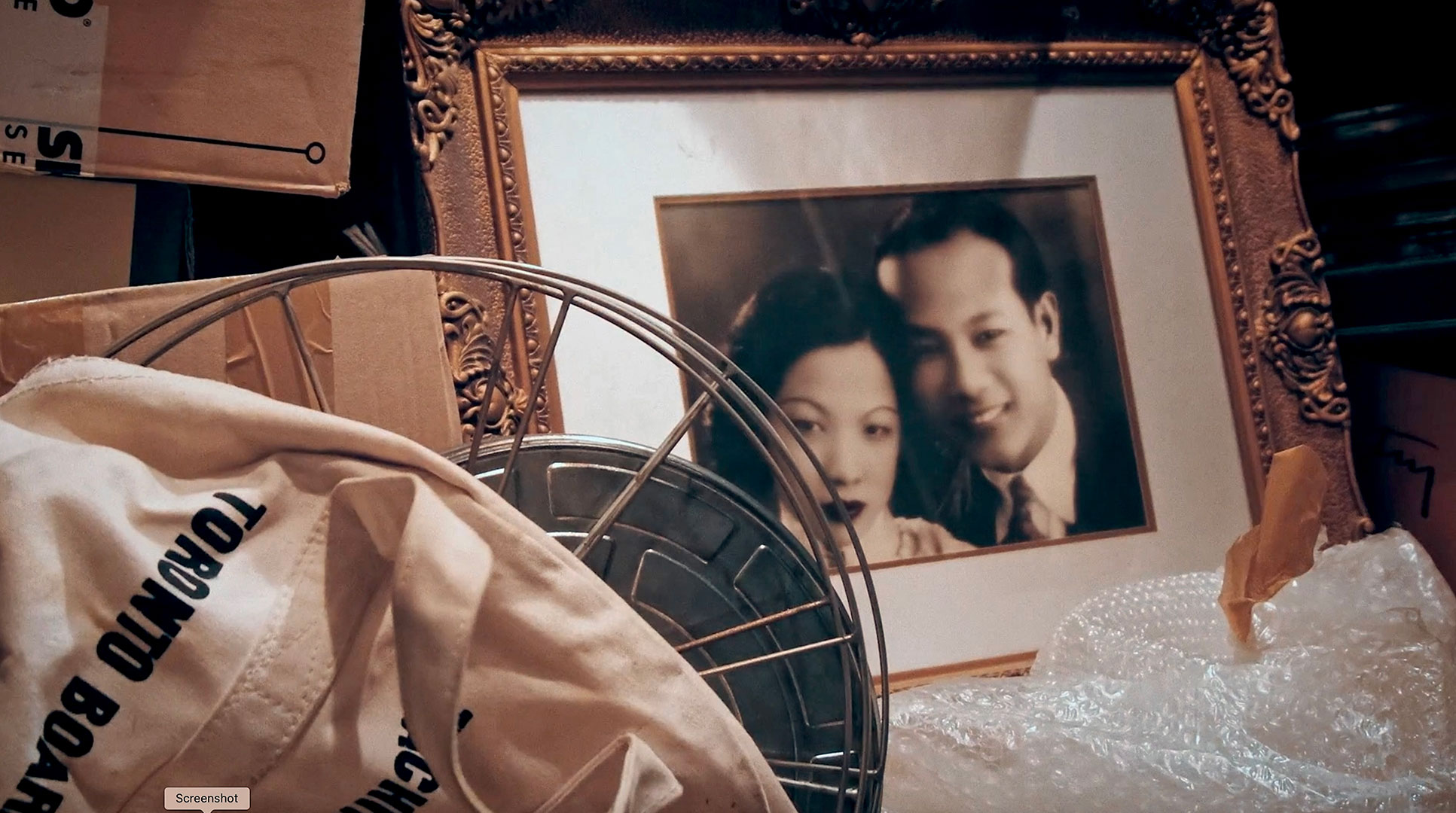
팔림프세스트: 이름에 관한 이야기Palimpsest: The Story of a Name
감독 메리 스티븐Mary STEPHEN | France, Hong Kong, Taiwan | 2025 | 109 min | Documentary | 홍콩귀환: 시네마 + 아방가르드Back to Hong Kong: Cinema + Avant-garde