그녀: 공장의 전사들She
감독 파르시팔 레파라토Parsifal REPARATO | Italy, France | 2025 | 74 min | Documentary | 프론트라인Frontline
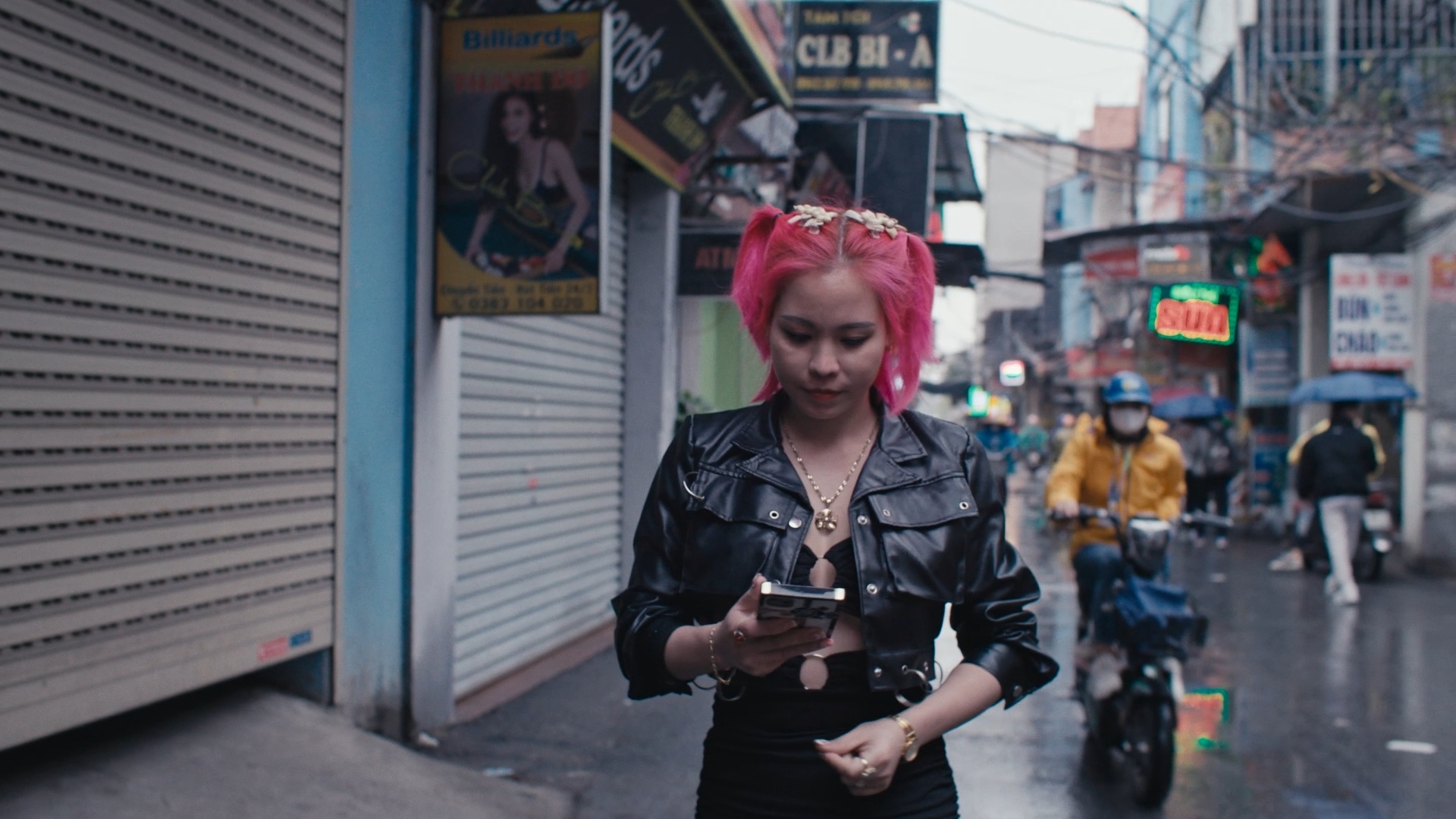
For Parsifal Reparato, cinema functions as more than a medium of documentation; it acts as “a catalyst of events, relationships, and understanding.” His film She, presented in the Frontline section of the Jeonju International Film Festival, follows women workers in one of the biggest electronics factories in Vietnam, distilling his anthropologically grounded practice. Rather than simply representing the experiences of others, Reparato seeks to create a space in which they can become subjects of their own narratives. In this approach, he naturally invokes the legacy of Jean Rouch. As the pioneer of cinéma vérité—who expanded the horizons of anthropology through film—Rouch suggested that the camera can become an extension of the body. Reparato, in turn, sets that body in motion to write new stories.
In She, you focus on Vietnamese women working in the electronics industry. What led you to explore this subject? Following your first documentary Nimble Fingers, how did this project come about, and what key questions or concerns did it begin with?
What led me to explore this subject has long been part of my life. It comes from a deep sense of belonging to the working class, shaped by my personal background and my political and activist experiences from a very young age. Growing up, I took part in workers’ protests and picket lines in my city in Italy, and that was where I began to understand how central the workers’ perspective is—not only as a social condition, but as a way of interpreting the world. Over time, I became convinced that workers’ knowledge offers a fundamental lens to understand the structural injustices of our present, and to imagine how to overcome them. A turning point came when I graduated and worked for a large USA multinational company producing electronic devices. Even though I was not a factory worker, I had the opportunity to closely observe the broader system of global production and exploitation behind these corporations. That experience raised a crucial question: what actually happens at the core of global electronics production? This question led me to Vietnam for the first time in 2011, where I began the journey that would become Nimble Fingers. She emerged later, as part of a longer and more structured research process. I worked in collaboration with the University of Naples L’Orientale and the Vietnam Academy of Social Sciences, and in 2020 I was involved in a EU-funded research project focused on trade union representation and the empowerment of civil society within electronics factories. The film is thus rooted in both a personal trajectory and a long-term research process, driven by a central concern: how global systems of production shape workers’ lives, bodies, and possibilities—and how, within these conditions, forms of awareness and resistance can still emerge.
As a European male scholar and artist, this project seems to involve thinking about your position as an outsider. How did you begin to think about this difference in perspective at the beginning, and what kinds of questions did it lead you to consider as the work developed?
I understand why my position might be seen as that of an outsider. But I don’t perceive myself in those terms. Rather, I see myself as giving form to a perspective that is widely shared, yet often silenced—a perspective that belongs to the vast majority of people, but is rarely represented in mainstream discourse. We are constantly exposed to narratives that serve the interests of global capital, often erasing or marginalizing the voices of workers. I come from that world. I belong to the working class, and that is the standpoint from which I began to think and work. This process has never been individual, but developed through collective work with workers and researchers. Michela Cerimele, who has extensive experience on labor issues in both Italy and Asia, played a key role in grounding the work. The broader research framework, including scholars like Pietro Masina and Do Ta Khanh, helped create a space where questions could be developed collectively over time.
What has guided me throughout is a shared condition rather than a distance. The injustice experienced by these workers is not abstract or external—it resonates with a broader global reality. In this sense, Vietnam is not an isolated case. It represents, in a concentrated form, the dynamics of global capitalism today—where technological progress and the rhetoric of Industry 4.0 are built on the bodies and lives of workers. This has been true not only in Vietnam, but also in South Korea, India, Indonesia, and increasingly again in Europe and the United States. So rather than thinking in terms of inside or outside, I see this work as an attempt to connect structurally linked experiences. Vietnam becomes a lens—a way to read the condition of the working class globally. And it is from within that condition that I speak.
This film carries a depth that seems difficult to achieve through straightforward reportage alone. Could you talk about the time you spent meeting and getting to know the participants before filming, and how you invited them to take part?
This film is far from a simple reportage. My background is in anthropology, and before working as a filmmaker, I always conduct research as an anthropologist—engaging in ethnographic work and immersing myself in the communities I want to understand. This process takes time.
This project began as a collaboration with universities and trade unions, and I was initially supposed to create an advocacy video. But the research coincided with the pandemic, and instead of staying in Vietnam for three months, I remained for seven. Those seven months were fundamental. I met hundreds of workers living in the industrial area of Bắc Ninh. At first, there was a strong sense of fear—not only towards me, but also towards the Vietnamese researchers. Speaking about working conditions could have serious consequences, so trust had to be built slowly. In the early months, I focused on interviews and observation with my assistant, Phuong Minh Nguyen, trying to understand a wide range of experiences. Over time, I developed closer relationships with a smaller group of women workers. They began to recognize a common ground—something that comes from a shared condition within the working class, even across different countries. This process deeply influenced the form of the film. From the very beginning, protecting the workers’ anonymity was essential, in order to avoid any risk of retaliation. Everything that appears in the film comes from the trust they chose to give me, often in the very limited time they had outside of work. For this reason, I see the film not as something I made alone, but as something that emerged from a collective process—grounded in trust and collaboration.
It wasn’t possible to access the factory interiors, and it was also difficult to show the participants’ names or faces. Within these clear constraints, the film moves into more intimate spaces, like the women’s small rooms or hair salons where they can speak more freely.
No, it wasn’t possible to film inside the factory, and this wasn’t new to me. I was never interested in “stealing” images from that space. What mattered was to represent the workers’ point of view—not the perspective controlled by corporations, but the one they try to silence. So the key question became: how can we create a space where workers can express their experience in their own terms? The answer was to focus on their expressive capacity—to give space to the knowledge embodied in their bodies. For years, there has been discussion about “workers’ knowledge,” and here that knowledge is inscribed in their gestures, in their fatigue, in their bodies. This is why the film pays close attention to details—hands, faces, small movements. Through these, the women reveal something deeply human: vulnerability, strength, emotions, even wounds. These elements allow us to connect with them in a concrete way, beyond abstraction. This approach also aligned with the need to protect their anonymity, which pushed the film toward a more abstract and performative language. The choice of the hair salon as a central space emerged progressively during the research. Around industrial areas, beauty salons and small spas are extremely common. They are both a means of livelihood for workers leaving the factory and a space where they can experience a moment of relief and reclaim themselves. Inside the factory, their bodies are strictly regulated: they wear uniforms for long hours and are controlled in every detail, from their hair to their nails. In contrast, the salon becomes a space of care, intimacy, and temporary freedom.
One of the most striking elements in the film is the performance where labor is “re-enacted” in an empty space, rather than inside the factory. Filmed in black and white from three angles, these scenes at times resemble CCTV footage. How did you come to these formal choices, and what do you think they made possible within the film?
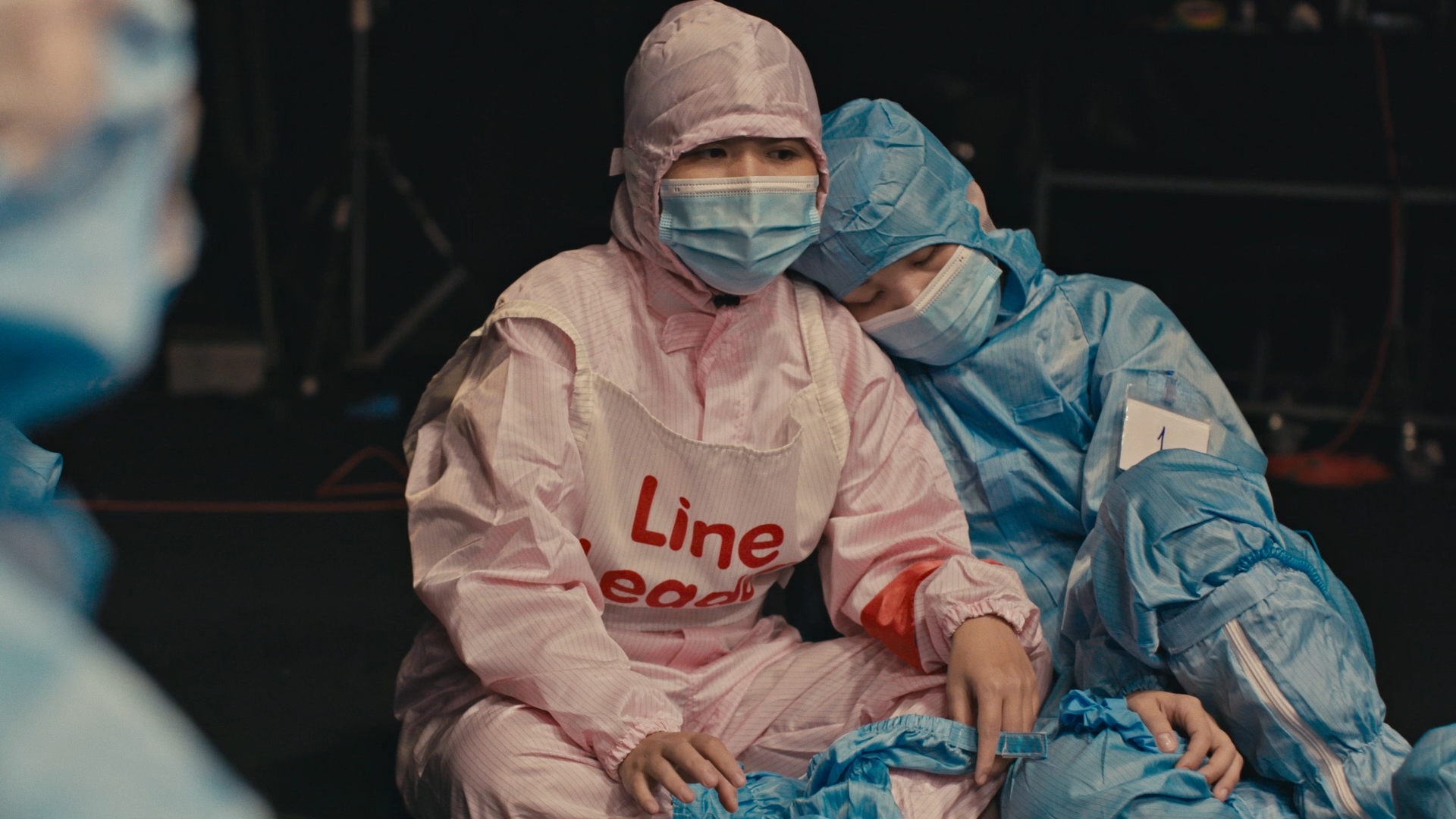
This approach did not begin with the idea of re-enactment. It emerged from a more fundamental need: to create a tool that workers could use to express themselves more clearly and freely. I felt that the most appropriate space was a symbolic one—an empty, enclosed, and dark space. Factories are in fact very bright, with artificial neon lights on 24 hours a day. But what the workers described was not brightness—it was pressure, confinement, and control. So the intention was to represent the factory not as it looks, but as it is experienced. We organized a workshop in this space, without a script. The workers did not know each other, and they arrived with their faces covered to protect their identity. In a situation where no one knew what would happen, they performed gestures and routines from their daily work experience. What you see in the black-and-white sequences is the result of that process. A key turning point came with the introduction of what I called the “truth space.” At that moment, I told them: now you are free. You can do whatever you want. You can reflect on what you have just shown, or express any emotion you feel. The line leader, who represents authority inside the factory, was also present. The workers could react in any way—even with violence, if they had wanted to. But what emerged was something very different. Instead of revenge, they expressed a deep need to be recognized as human beings—a demand for dignity and acknowledgment. This became one of the central lessons of the entire process.
It’s interesting that your background is in anthropology. In your documentary practice, how do you experience the differences between fieldwork, building relationships, and translating those experiences into film? Over time, how have you navigated or expanded your interests between academic documentation and cinematic representation?
For me, fieldwork is first of all about building relationships. At a certain point, it becomes more than just a research method—it becomes a way of life. Anthropology taught me something important: the idea of complete objectivity in science is, in many ways, an illusion. What gives ethnographic research its strength is not neutrality, but subjectivity—the ability to create relationships, build trust, and develop connections through lived experience. Over time, this has become a method. It’s something I have tried to share and transmit through the Ethnographic Filmmaking Lab, which I founded in Italy. Each year, we work with young filmmakers, encouraging them to develop their projects through ethnographic research—spending time in the field, engaging with people, and letting stories grow out of experience. Filmmaking came as a natural extension of this process. For me, cinema became a way to go further. It is not just a tool for representing reality, but a catalyst—a catalyst of events, relationships and understanding. It allows me not only to observe the other, but to create a space where they can represent themselves and participate in shaping the narrative. This is something that written or academic language often cannot achieve with the same intensity. Cinema can reach people differently—not only in terms of audience, but in terms of engagement and shared experience. It opens the possibility for people to become active subjects of their own stories through a more immediate and embodied form of self-representation. As Jean Rouch suggested, the camera can become an extension of the body—a kind of prosthetic device that amplifies reality and transforms observation into a process of mutual discovery. In this sense, filmmaking is not separate from fieldwork. It is part of it. It is another way of knowing.
I understand that your next project will also focus on factory workers, forming the final part of a trilogy on labor. Could you share a bit in advance about how it connects to your earlier works, Nimble Fingers and She?
What I can say is that I continue to see wage labor—and the conflict between capital and labor—as one of the most important keys for understanding our time. This body of work has been a journey. Through filmmaking, I have sought to go deeper into the lives of the people I work with, while also exploring the broader structures that shape those lives. More recently, I have become increasingly interested not only in working conditions, but also in the imaginary—in what exists beneath the surface of everyday life. The aim of this project is not only to document, but to offer a way of interpreting reality—and perhaps to provide tools to think about how to transform it. For me, cinema is a way to make visible the structures that usually remain hidden: the social and economic systems that sustain the dominant order. Focusing on the electronics industry means going directly to the core of these dynamics, where many of the contradictions of contemporary capitalism become visible. This is what connects these films. They are not separate works, but different chapters of the same attempt: to understand, and to make visible, the conditions that shape our present.