두 배의 자유La libertad doble
감독 리산드로 알론소Lisandro Alonso | Argentina, Chile, Luxembourg, Germany, United Kingdom | 2026 | 100 min | Fiction
A Brief Introduction to the Life and Work of Lisandro Alonso
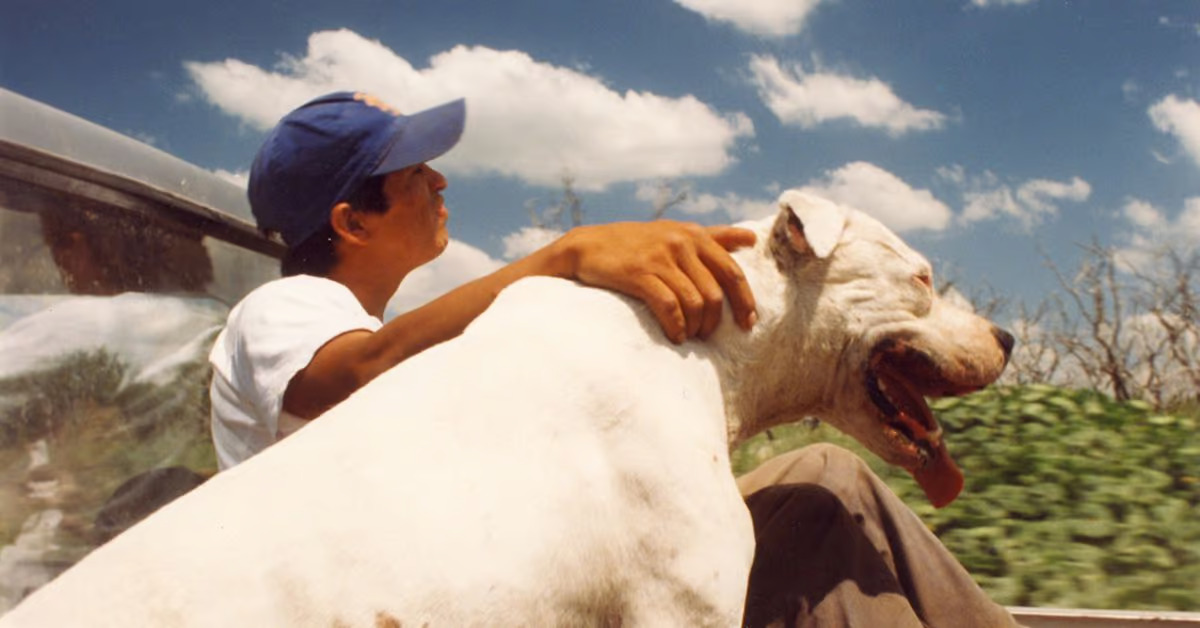
The year was 2001, and Argentine cinema was experiencing a boom (while simultaneously going through one of its worst economic and social crises) thanks to the generational shift that would later be called the “New Argentine Cinema.” It was the era of the debuts of names like Lucrecia Martel, Pablo Trapero, Rodrigo Moreno, and others. During those same years, a young film student who hadn’t finished his studies decided to make his first feature film. With a loan from his family and the collaboration of a small group of technicians and friends, Lisandro Alonso filmed La libertad (2001). The film told us—or rather, showed us—the life of a young lumberjack in the Argentine Pampas with a slow but precise style, almost like the protagonist’s movements as he cut logs. The film eschewed all kinds of narrative devices and formal flourishes, but at the same time, it wasn’t a mere documentary. Rather, it was a work of fiction with a protagonist playing a version of himself. Those who first saw La libertad didn’t know how to react to what they saw. They spoke of a boring, unimaginative film; even the person who later became the film’s distributor told the director, “This isn’t a film.”
Things changed when Eduardo Antín (known as Quintín), director of the then still-young Buenos Aires International Festival of Independent Cinema (BAFICI), saw the film on a VHS tape and, surprised by what he saw, decided to invite it to the festival’s competition. But things got complicated, in a good way, since the person responsible for selecting films for Cannes was in Buenos Aires and almost simultaneously recognized the merits of Alonso’s film and invited it to the prestigious French festival. However, there was a condition: the film’s original ending was a shot of the protagonist, Misael Saavedra, looking at the camera and laughing almost uncontrollably. The French demanded that this shot be cut if they wanted the film to be included in Cannes. The young and inexperienced director accepted the condition, and that now-legendary shot disappeared from the final version of the film.
La libertad finally premiered in the Un Certain Regard section at Cannes, where it nearly won the prestigious Caméra d’Or award (according to some of the jury members, such as the French director Claire Simon). The film left the French festival without any awards, but it made a real impression on critics, who saw in Alonso the birth of a new auteur. The films that followed in the director’s filmography not only confirmed this talent but also demonstrated that his refined style was no accident. Both Los muertos (2004) and Liverpool (2008), as well as that metacinematic exercise, Fantasma (2006), further solidified his vision of a cinema that was both rigorous and ascetic.
Then came the “international years,” to give this part of his filmography a name, in which Alonso’s cinema abandoned those early films and production methods and launched itself into the conquest of international cinema and the white whale of Cannes and its official selection. Both Jauja (2014) and Eureka (2023) are films in which the director changed and doubled down on his approach: international actors like Viggo Mortensen and Chiara Mastroianni, prestigious technicians like cinematographer Timo Salminen, a frequent collaborator of Aki Kaurismäki, and a lavish style of filmmaking in which the different narrative layers functioned like a puzzle whose pieces, ultimately, didn’t quite fit together. These are no longer minimalist stories with rigorous staging, but rather works of complex narrative where the dreamlike intersects with the real, geographies intertwine, and Alonso’s talent appears only in flashes—in scenes or sequences—but never in the consummate form that his previous works had displayed. We can speculate that the troubled shooting of Eureka—that was set to begin at the same time the COVID pandemic broke out—and another rejection from the Cannes Film Festival’s Competition led its director to consider a return to the Argentine pampas and his first film. But this is just that, speculation. Whatever the reasons, the moment had arrived to return to freedom.
Returning to Freedom
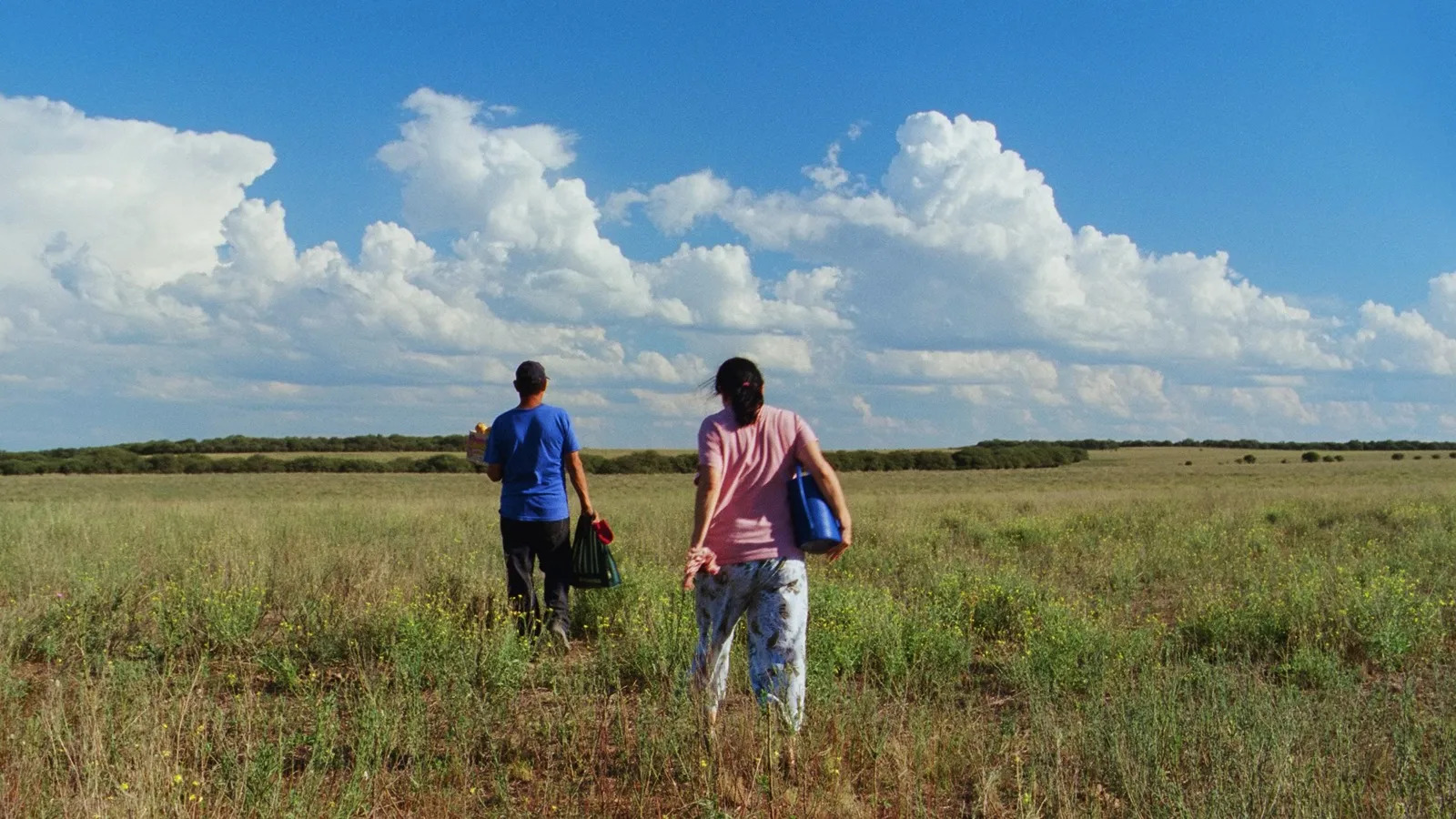
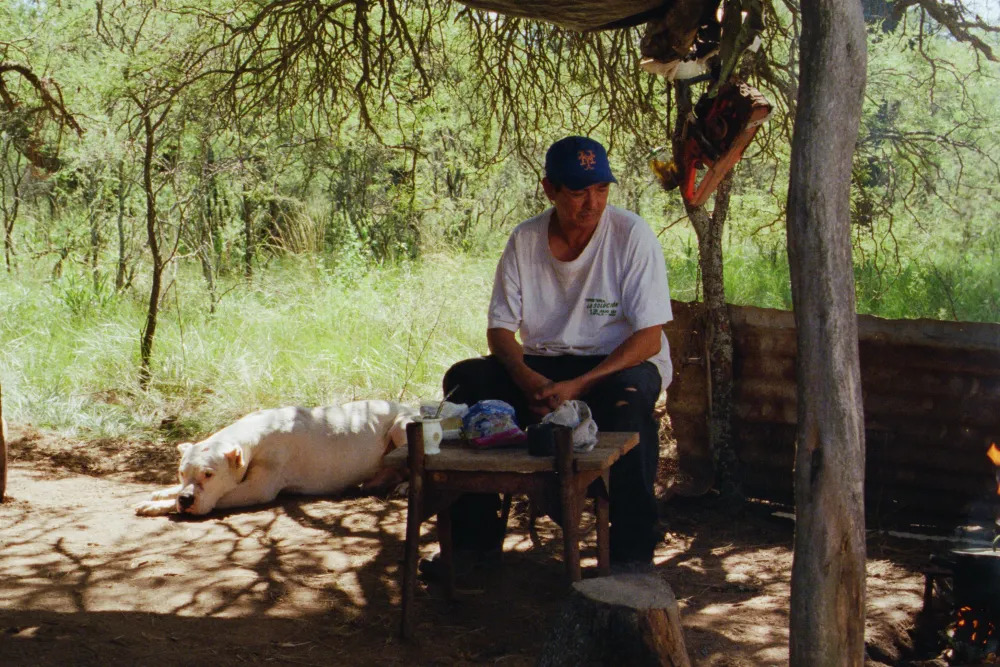
The opening of La libertad doble might lead viewers to believe they are watching a remake of its predecessor. Like the 2001 film, the first image we see is of Misael Saavedra shirtless, eating alone at night, while in the background, flashes of lightning foreshadow an approaching storm. But of course, time has passed, and the protagonist’s face is no longer that of a boy, but that of an adult man. His life remains the same: cutting down trees, buying supplies, waiting for the day to end and for night to fall. He is even accompanied by a white dog similar to the one in the first film. The director portrays his protagonist’s tasks and the spaces he inhabits with the same patience and delicacy, returning to the rigor of the first installment to patiently show us this life without constraints, far removed from civilization.
However, not everything is the same; some things have changed, or are about to change. Shortly after the film begins, we learn that our protagonist has a sister who is in a hospital on the verge of closing because the state has stopped providing the funding necessary for its continued operation. In this gesture (namely, the creation of this character), Alonso does something unexpected in his work: he offers a commentary on the social situation in his country and the neglect suffered by institutions (such as hospitals, schools, and cultural spaces) in contemporary Argentina. Misael Saavedra’s sister (played with incredible realism by Chilean actress Catalina Saavedra, who, despite sharing the same last name, is not related in real life to the other protagonist) must leave the hospital and be cared for by her brother. The portrayal of these two characters, isolated from the world—one consciously, the other not—also adds something previously unseen, or at least not so explicit, in the director’s films: the emergence of the concept of care between two characters. Between them, they create a society, small, minimal, but a society nonetheless. Another person to care for and with whom to live. And with this comes emotion, a measured emotion, almost muted, but emotion nonetheless.
Twenty-five years have passed since the premiere of La libertad (almost the same age Lisandro Alonso was when he directed the film), and the world—not just the world of cinema—is different. Listing all the changes that have occurred in those almost three decades would be an endless and unnecessary task, but it is worth highlighting some changes in cinema: the definitive shift from analog to digital technology and the emergence (and imposition) of images through social media, which have completely changed the perception of cinema and the images we viewers consume today.
Watching La libertad doble today seems to take us back to cinema’s past, a not-so-distant past, but a past nonetheless, where cinema could be something else: an art with its own language, far removed from the monetary demands and the frenetic pace of the modern world (just look at the films participating in Cannes and see what they have in common: increasingly large-scale productions—financially speaking); and perhaps that is what cinema is: an eternal past to which we can return. That’s why, when one of the Lumière brothers told us that cinema is “an invention without a future,” perhaps he was telling us that cinema is pure past. But to return to that past, one had to first travel the path that Alonso traveled with his cinema.
*Postscript: Using the term “spoiler” to talk about Alonso’s films sounds ridiculous, yet what follows is precisely that: a spoiler.
At the end of La libertad doble, after the credits have finished, the film finally concludes by returning to that original shot from La libertad in which Misael Saavedra, the protagonist woodcutter, looks directly at the camera and laughs heartily. With this gesture, Alonso not only recovers the original ending but also exacts a kind of revenge on Cannes, the festival of which he always, in one way or another, felt himself a part, but to which he never truly belonged.
자유La libertad
감독 리산드로 알론소Lisandro Alonso | Argentina | 2001 | 73 min | Fiction
두 배의 자유La libertad doble
감독 리산드로 알론소Lisandro Alonso | Argentina, Chile, Luxembourg, Germany, United Kingdom | 2026 | 100 min | Fiction