포에버…포에버Forever…Forever
감독 요한 루르프Johann LURF | Austria, France | 2026 | 21 min | Experimental | 영화보다 낯선Expanded Cinema
Some films still make us step back and think about what it really means “to see.” From that distance, what appears are the mechanical devices that make cinema possible, the different realities produced through those devices, and the people who witness those realities together. To understand what we have seen, we must once again enter those images and begin to wander through them. But why do we need to keep thinking about the act of seeing? Is it because seeing shapes the way we understand the world? And if so, what should we call those who live within these machines in order to create other realities through images?
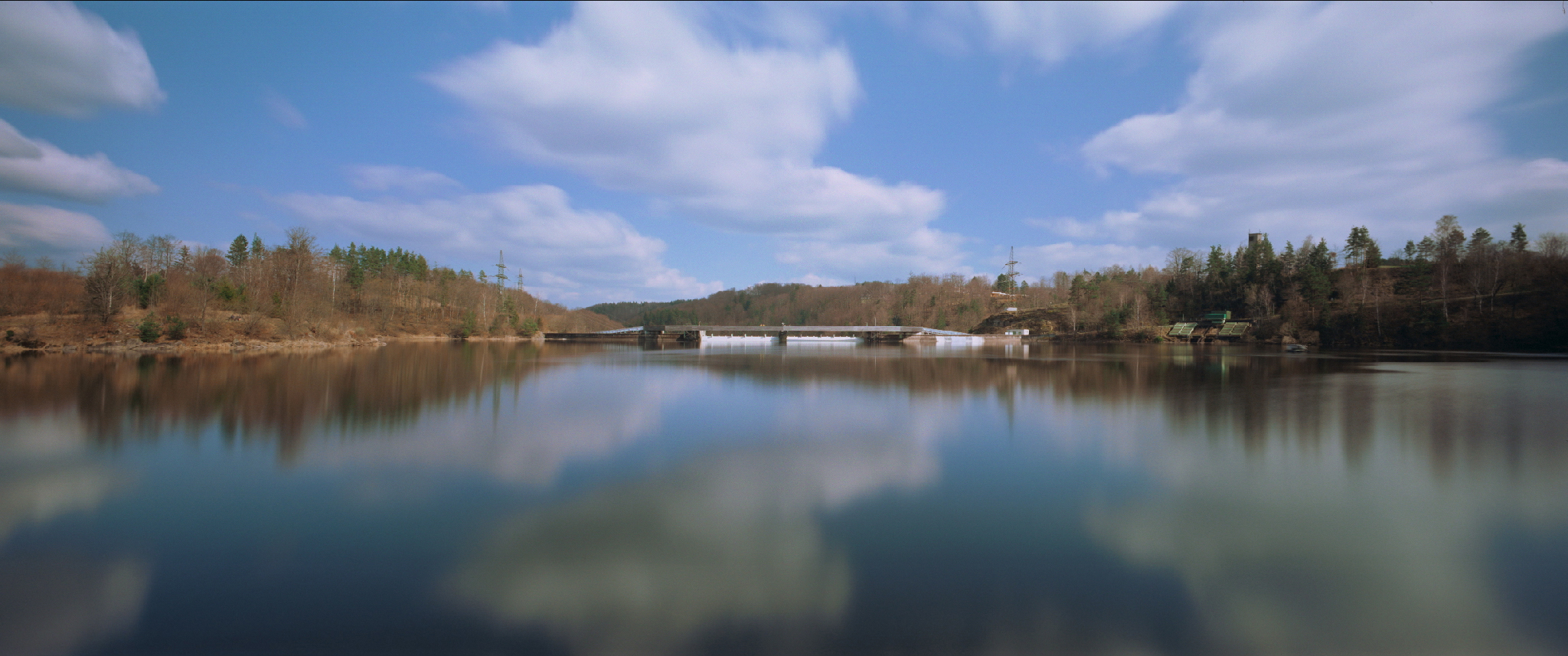
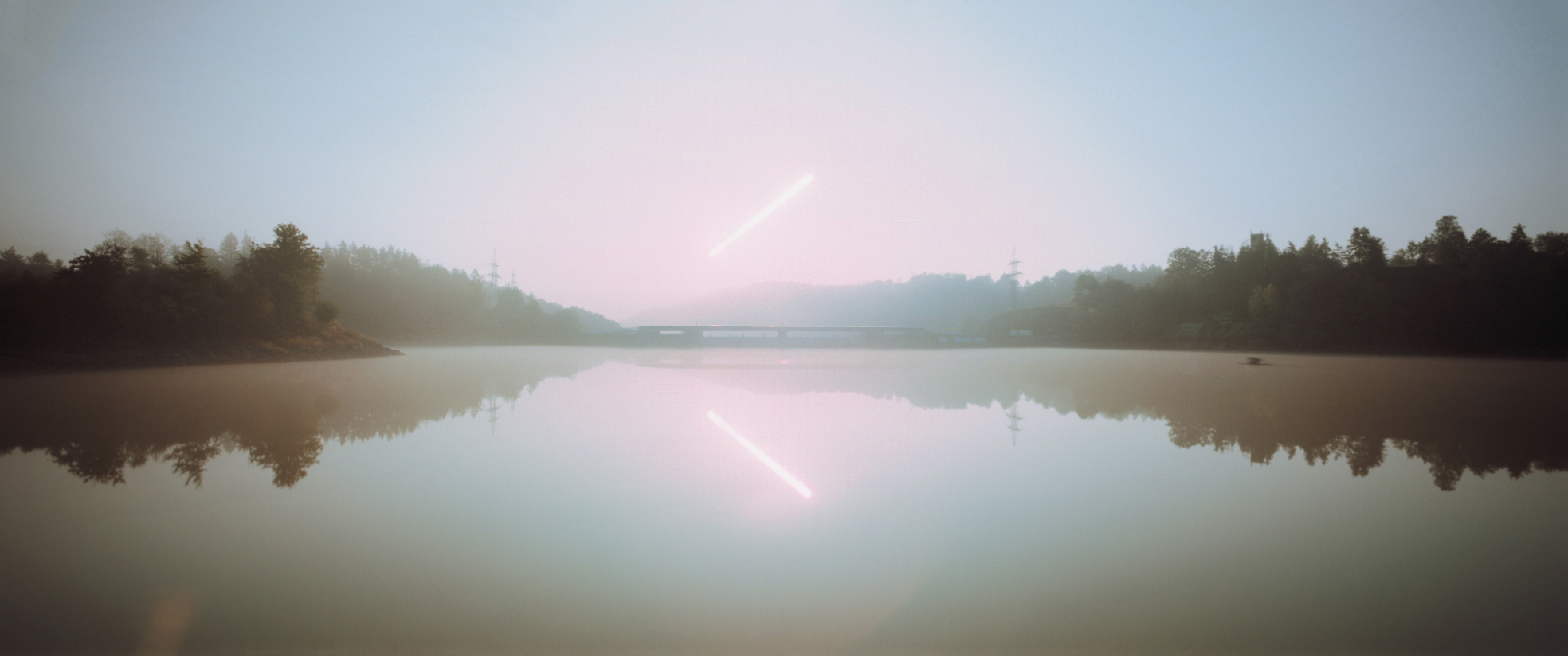
Forever…Forever was filmed over 22 months from a fixed viewpoint, showing the Ottenstein Reservoir. At first, the reservoir looks like a normal and familiar landscape. But as the film continues, it slowly becomes a surface that reflects the sky—its changing weather and celestial movements—in a more abstract way. By the end, it can even feel like a metaphor for cinema itself, as a place where light is at work. Compared to your earlier film RECONNAISSANCE (2012), which focused on the Morris Reservoir in California—a site once used as a military facility—this work seems to take a different approach to the reservoir. Could you talk more about this?
The film tries to grasp larger scales of time, and I wanted a man-made structure to be in the center of our view, so we can relate better to the landscape. A dam wall is one of the most solid buildings, withstanding the forces of nature to a large extent. It transforms the landscape; it washes out and covers up the old river bed and creates a new shoreline. New life takes place on the surface, and the river’s history is hidden under water—we can only imagine it down there, somewhere. The movement and the lights in the sky are the main events in the film, so I wanted to emphasize that with the lake’s mirroring surface.
As the film moves toward the later part, the image no longer feels like a landscape but more like abstract movements of light. This seems to happen because the film “accelerates.” It may be the result of the film’s structure, where the exposure time for each frame gradually becomes longer—from 8 seconds up to 24 hours. In this sense, your film could be seen as creating a kind of fiction out of reality through speed. Your earlier work VERTIGO RUSH (2007), which uses zoom-in and zoom-out movements, also seems to experiment with this idea of creating fiction through acceleration. In your work, what does “acceleration” do, and what does it mean to you?
I would rather use the word experience instead of fiction, as the perception of the more abstract parts in both films are very subjective and so different for each individual. Indeed, the acceleration creates this abstraction, but only for our own senses, as humans are used to perceiving time in the usual scale of our present. Trying to imagine a different way of perceiving time, on a non-human scale, is very hard. The film makes it possible to perceive an accelerated flow of time; it also makes us see how it would feel if the flow of time itself were to accelerate gradually, finally increasing faster and faster in an exponential way. The film points in a direction like an arrow, and I hope the viewers can imagine this accelerated passing of time further, even after the film has finished. It’s important for me that this acceleration was actually filmed in camera and not artificially designed by our ideas of how this would look like.
In terms of theme, this film also seems connected to your long-standing interest in the relationship between vision and the universe. The first work of yours I saw was ★ (2017), which explores how the universe has been represented in cinema in a very original way. After watching it, I felt that exploring images is not so different from exploring the universe. How have your questions about images, cinema, and the universe continued in your work?
Understanding the universe is of fundamental importance to our being. Vision and hearing are the means of our perception for learning about our surroundings, and cinema brings all of these elements together. The history of images made of the universe for cinema is just one example of how we can research within images, and so much more can be learned from the images of the past. I’m most fascinated by the possibilities of the tools we designed to see further into space and into microscopic structures, to extend the range of our view, so both the history of images as well as more recent possibilities of image taking informed the research for and the concept of Forever…Forever.
I understand that you invented a new 65mm film camera for this project. Could you tell us more about how you designed and used this device?
I built the camera as a versatile tool which I can program in many ways. It does not need to run linearly like a conventional camera; it can gradually bend time by changing the exposure time for each frame. It consists of sprocket rolls from 70mm projectors, a photographic lens for large format film, motors, sensors, and a computer controller. I built it not only for this project but also for future films with different structures. Basically it is a hybrid between a large-format still camera and a motion picture camera, which measures the light automatically and can be programmed to operate autonomously.
In relation to Forever…Forever, are there any historical contexts of experimental cinema that you were thinking about or responding to? (After watching this film, I naturally thought of Michael Snow’s works. In terms of observing a single point over a long duration, Wavelength (1967) comes to mind, and in terms of looking at the landscape from a non-human perspective, La Région Centrale (1971).)
Of course, Michael Snow’s work is always in my mind, in my heart.
This film seems to go beyond the audiovisual and asks for a more physical, full-body experience of perception. In that sense, it feels like it emphasizes the importance of the cinema as a space. The screen is not just a surface for images, but a place where light performs, and the sound is not only something we hear, but also something we feel as physical vibration. More broadly, your films seem to keep experimenting with how we “see through depth.” In this context, your work seems to support the unique experience of the cinema in its own way. Could you share your thoughts on the cinema as a space?
What I love about cinema is that it is perfectly designed for our senses: the reflective projection is easy on our eyes, also with extended viewing. The film grain structure creates an impression of depth in the pictures, which relates well to our eyes’ perception. The sound surrounds us and can change the space dramatically with its fine tunes. We agree to focus on the film with all our senses and are rewarded with a time to contemplate, feel, and be inspired. It couldn’t be much better.
Cycle, repetition, and the structuring of time seem to be central questions in your work, including this film. If this film could continue repeating “forever…forever,” what do you think we would see?
There is no repetition of pictures in my films, ever. The structures in my films are rhythmic but always play in variations. Each cycle contains a shift, which is sometimes more, sometimes less obvious. This way we can get immersed in the pictures and sounds and discover details we would have missed otherwise. Each time I watch the film, I see it in a different way. I bring my own perspective, which is not a constant, but rather a fluid and sometimes changing point of view. I believe it’s the same for everyone else, and one of the reasons why I make these kinds of films is to hear from the audience about what they have seen, which is often very surprising.