갱스터리즘Gangsterism
감독 아이제이아 머디나Isiah MEDINA | Canada | 2025 | 84 min | Experimental | 가능한 영화Possible Cinema
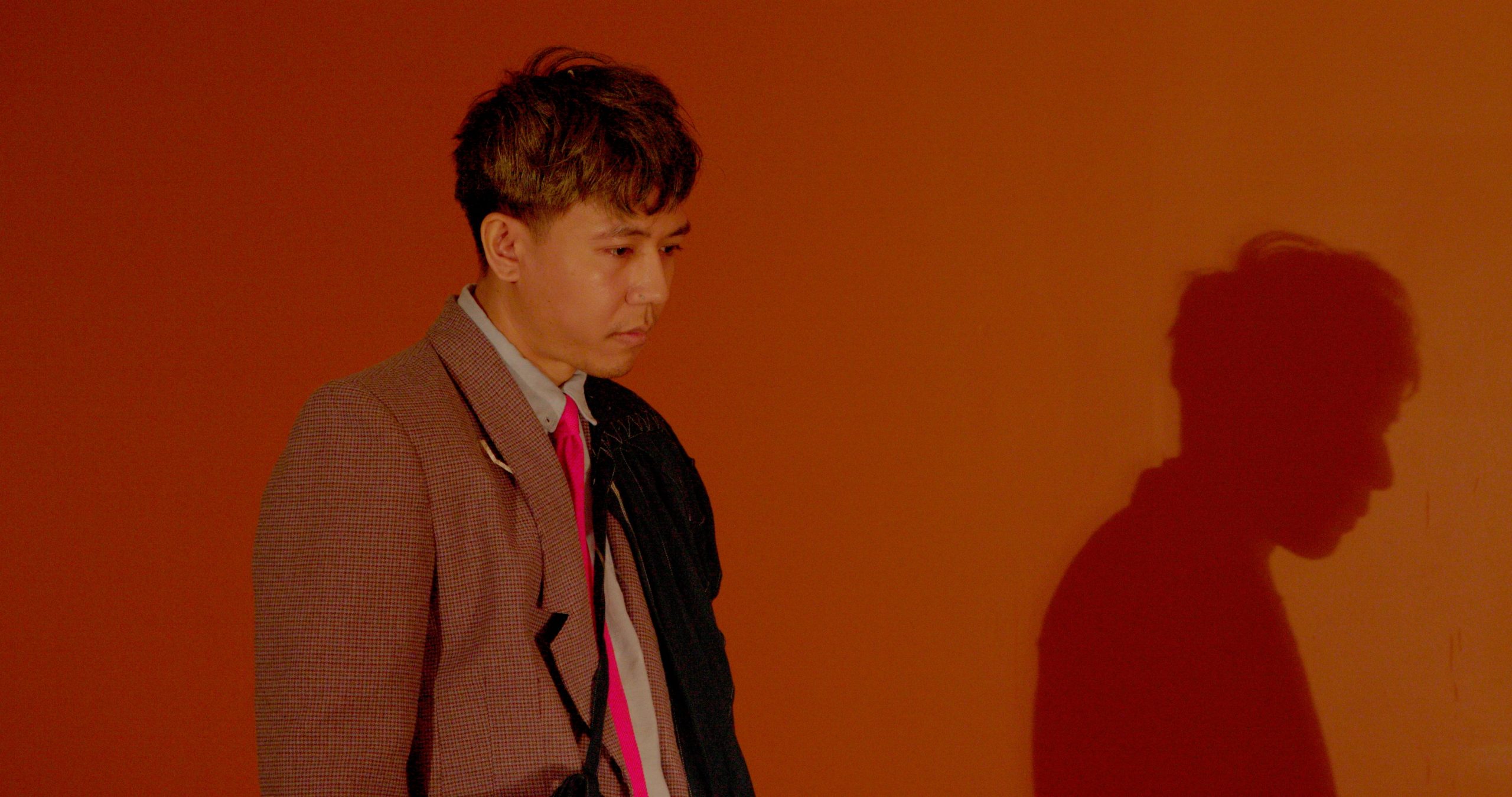
After presenting Night is Limpid at the JEONJU International Film Festival in 2022, Isiah Medina returns with his new feature, Gangsterism. Conceiving filmmaking itself as something “gangster,” Medina’s latest work reflects on what it means to speak through cinema amid colonialism and racism, wars and genocides unfolding across the globe, and the digital conditions surrounding contemporary film culture. The film traces a singular movement in which a gangster-like drive to say everything through cinema folds back onto the act of filmmaking itself, continually provoking thought throughout its runtime. What follows is a selection of Medina’s rich responses to the perhaps clumsy questions that arose while watching the film.
I’d like to begin with the title, “Gangsterism.” The film largely avoids the kinds of violence we usually associate with the gangster genre, and profanity appears only rarely. Yet just as gangster films leave us with countless memorable lines of dialogue, it unfolds through exchanges between artists who are, in a sense, positioned as “gangsters.” If the gangster figure often gives characters the freedom to speak without restraint, Gangsterism seems to invoke the gangster in order to open up intense conversations on subjects ranging from cinema itself to genocide. What drew you to the figure of the “gangster” as a conceptual or cinematic device for the film?
I liked gangster films growing up, I like how it inspires people to try things in life, to say or do what you want. Stanley Kubrick said artists and criminals don’t accept reality for what it is, I find that moving, in the same manner that Socrates was seen as a criminal for corrupting youth and showing impiety to gods by the Athenian state. It’s to be a partisan of desire against the law because in the world of art most people are for the realism of the law. It’s about freedom. If you’re of a certain part of the population, no matter what you do you will always be perceived as a criminal or doing something wrong, you can watch every picture or read every book it doesn’t matter, so who cares, do what you want, I’m old enough to know that no one will ever respect me as a thinking human being anyway so might as well live freely and do whatever I feel at any moment. Growing up I remember it just being a positive term, like “that’s so gangster.” It’s not like you’d grow up as a kid and be like “wow, that’s so lawyer.” Too many people are all about lawyerism and want to put Socrates to death for showing impiety to their gods.
In some ways, your earlier works made in Winnipeg—such as Semi-Auto Colours and 88:88—can feel closer to the traditional image of “gangster” films. Perhaps because they were made with friends in the place where you grew up, they give the impression of a real “gang” of friends, with speech that feels spontaneous rather than scripted. By contrast, in films like Inventing the Future and Night is Limpid, where filmmakers perform as characters and the dialogue appears more structured, it feels as though your “gang” has shifted—from a local circle to something closer to the film or art world. Have these changes in location and collaborators shaped the way your films take form?
The circle is still local, and it must be, because making cinema happens in front of us. I don’t really know people from the art world or film world, I just know some artists, I know some filmmakers, and some thinkers, sometimes writers and critics, and we’ll make something, and I’ll figure out how we can see it on the big screen, and sometimes someone wants to help us see it on the big screen. Basquiat said there is no art world, just some painters and some dealers. It’s true. The rest of it is a masquerade of proximity.
When I was younger I only knew artists, and then I began to meet other people, and started to know too many who want some closeness to art without any real thought or work regarding it, people who want to keep their job and hang around art and artists so they can act like they’re tasteful and their life isn’t simply an appendix to choices regarding property relations. I quote this a lot, that when you’re twenty and a poet it’s because you’re twenty but when you’re forty and you’re a poet it means you’re a poet. But there are still those who are forty plus who aren’t poets, even in private, and they need to hang around and give you their middlebrow top ten movies of 2026 which have more to do with showing off access than any capital T Thought regarding cinema. Also they need to tell you their Cannes line-up predictions or whatever. That’s the world. Many aging scenesters and scenesterism. They don’t like art, or only like art as much as travel, or cheese, or bourgeois adultery (a marked difference from that of the proletarian type which is a discussion for another time), or cottages, or degree programs.
Of course art changes the world, beyond the art world, just not on the timescale you expect. Art changes the history of thinking, and thinking will always be more important than the world. I make art to be able to think at a certain pace, so I have to keep a sort of circle that allows for that pace, and most of the world, whether it’s art or film or whatever, is constructed to make you stop. You can even say “art world” is like saying “human animal,” there’s a hidden preference for “world” or “animal” in this regard, to de-subjectivize you and make you finite. All these art world limitations and realisms are mirages that artists are expected to buy into so the curator and donors can afford their apartment where they present their terrible taste. And a lot of people still make art for their parents, worry what they think . . . things like that.
In regards to whether people are more scripted or spontaneous, it’s the same. I script spontaneously, and when I speak spontaneously it feels scripted. Some extemporaneous things were said in my early work, but a lot of it was said in life and I asked for it to be repeated. A lot of my scripts are things me or my friends have said in so-called real life.
So in the end my circle should remain artists, or thinkers of some sort, it doesn’t have to be art. Or even just being a kind person. But as Scorsese said the people in the film world are more rude than anyone he’s met in the streets. Your circle shouldn’t include the world, your circle helps you survive the world and fight it.
I don’t think the location or collaborators have changed how my films take form, they take form in an immanent relation to the past works I made, or historical works, or things I think should be made. I respond to works, not worlds. You can’t go to the world directly, you have to look at the history of forms to understand how the world even appears to us, and why it takes this or that form of appearance rather than another.
Since the COVID-19 pandemic, the primary space for cinema has shifted online. As Gangsterism directly addresses leaks and piracy, we can see that unauthorized circulation has become more active following the rise of online screenings by festivals and cinematheques. In a sense, it makes one think of the modern “pirate” as a Prohibition-era gangster, using external hard drives and cloud storage as their hidden warehouses. I also noted in a previous interview that you once made your films available on YouTube before taking them down. Given this landscape of piracy and the unregulated distribution of digital cinema, what are your particular thoughts or concerns regarding the production and circulation of your work today?
I thought with digital there’d be an explosion of new cinematic forms but instead we have a gluttony of unthought cinephilia, which is not the same thing. I was at a screening and then I went to the bathroom and the person in the urinal beside me was rating films on Letterboxd while urinating, and I think that’s a good picture of where we are today. There seems to be no distinction between producing waste and producing thoughts regarding the cinema. People are so entitled to pictures and give nothing to the cinema. They think peeing and thinking are the same. I think being and thinking are the same and we must think what is and not piss away the possibility of thinking. There’s some link between taking a leak and taking a leak in terms of its unthought dimensions.
I think especially if it’s a low budget picture, an experimental picture, some of these people think they’re helping filmmakers by watching leaks of work, giving exposure with non-thought. The desire to see something early, or rather, to log something before anyone, is so silly. Would you rate your life 5 stars in all honesty? And if not, think about that before you start thinking about cinema. Has anyone online produced a new ontology, a new theory of montage, anything at all? Or are they pissing away their lives? You can watch 10000 films and not have even 1 idea. I’m against all that “collector” consciousness, stupid aesthetes, the cheap desire to be a tastemaker, a collector of wines, coffees, travel, and movies, I find it completely disgusting. Fine, live that life, but these same people want a part of the thinking medium of cinema and want their opinion to matter.
I think filmmakers also need to put down their own money sometimes and put their picture in the cinema themselves and know what that feels like. You need to know that the curator who does not make pictures cannot be trusted to always recognize the next form when it appears. Even a critic as good as Clement Greenberg said it is always other artists who recognize what’s going on first. So recognize it in yourself first. Know it’s possible. There’s a sophistry that is normalized regarding who or what would be able to recognize when a new form appears. The explosion of the desire to curate rather than create is linked to an impoverished vision of artistic creation as mere curation and sharing of taste rather than invention in the void. The mathematician Grothendieck once said that we don’t study mathematics, we make mathematics. I don’t like the disrespectful attitude, the hatred of the cinema that manifests here. When it comes to the question of cinema I think it’s important to think beyond logos, and with TikTok the logo appears at the end, and watermarks can pollute your screener. People don’t watch cinema or the world, they just get good at reading text and logos, and logging and thinking become the same.
In terms of my films being online or not, it depends what I feel, what the strategy is for distribution at that particular moment for that particular picture, it’s not a law, because thinking is not related to laws in such a manner and if you think so you’re for the finite. But for example if my film plays here or there at a cinema or an event, I might put some of my earlier work back online at the same time. Or remove it, or count some as part of the oeuvre and some not, depending on what I’m making. We shouldn’t be all at once chained to all that may have existed.
I do think the fact movies can be freely downloaded is concretely utopian and shows communist plentitude can be real but I do think we have yet to solve the problem seeing movies at their proper canvas size, on the big screen, because the big screen is connected to questions of property and exclusion, and until that’s figured out I think artists should at least be respected enough so that their films don’t get leaked to the delight of hobbyists who watch 30 films a day and retain nothing.
Gangsterism brings up a range of political issues—such as colonialism, racism, and genocide—but it doesn’t offer direct commentary on them. Instead, as suggested by the screening section’s title, it feels like a “possible cinema,” where the form itself becomes a kind of statement. While watching the film, I was reminded not only of Godard’s political works, but also of Straub–Huillet in the actors’ delivery. Were there any key references that informed how you translated these political concerns into cinematic form?
What’s important is to think the forms, the history of forms and in the history you can imagine, you can think what could be next. You never know where it will come from. At one point Eisenstein looked to Walt Disney, thought through Snow White and the Seven Dwarves and Fantasia and went further with Alexander Nevsky and the Ivan the Terrible pictures. Of course it wasn’t just Disney, but it was one of many elements. Of course he has that interest in Joyce and Marx, et cetera. I look at set theory, but I also looked to Ye, which to me is like looking to Disney. When I took someone singing Leave the World Behind and slowed it down and sped it up and cut it up I was also thinking of, “And that one time that you left me, I didn’t get no sleep that night / And that one time that you left me, I took ten Percs to get high / Ten Percs to get high, pray that I don’t die / But if I die, I’ll see you in the sky / Two pints of the Qua’-Qua’, don’t leave just stay bae / Let’s go on a vacay, leave the world behind / Leave the world behind” from Cousins of Ye’s album Cuck.
The inventors of forms aren’t always on the same side as you politically but an artist should always ask themselves where invention is actually happening. It’s also perhaps the opposite: rather than translating political concerns into cinematic form, I think one should make cinematic forms immanently related to artistic problems. Seeing what thinking even looks like, or what cinematic thinking looks like, comes first. Seeing what thinking looks like we can then think politics cinematically.
So for example, Griffith and Instagram stories are both parallel montages, it doesn’t matter what politics you have, you will post in a Griffith-like manner with some close-ups and some crosscutting and carry all the history that it comes with. So if you are the first one to get to the new form of how we organize all these frames in a particular historical time you also have the chance to think its relation to politics first, that first link, what we will forever historically have to contend with. It’s not neutral and the moment of chance at the beginning determines the direction and reception. I’m glad Eisenstein invented more than Griffith, or Godard more than Spielberg. But Pagnol invented many things too. You have to be responsible for all of it.
It’s about looking at the history, looking at what’s on your big screen or your phones, walking around outside and looking there, and making something that could broadly include all of what we see, what we don’t see, and maybe at this moment, encompass our field of vision. We have to think of a form that can think the montage produced by the cuts and the intermittent mechanism that makes the world visible to us and how to change the relation between the cuts and intermittency. And when you look at the history there’s not too many, there’s some crosscutting and some Kuleshov and some intellectual montage and some jumpcuts really, so you can start making some experiments to think what the next manifest image can be that can hold it all together and add some new cuts so the world can appear as it appears in truth.
From your feature Inventing the Future—which draws on the book of the same title—to Gangsterism, your dialogue at times seems less oriented toward narrative progression and more toward exploring different “-isms.” When you write these dialogues, what are the main concerns or questions you keep in mind?
My main concern is following the idea to the end, and writing what I want to hear. Kieran Daly said music is not a language but perhaps language is a form of musical behaviour. I just write what sounds good to my ear, and things I haven’t heard someone say in a movie before, things I’ve said or heard in life, or things I should have said in life, or things I should have said more in life, or things I should say tomorrow. We are rarely in a condition where we can speak what we think.
I’ve been asked if I would make a purely silent experimental film but given the history of the world I think it’s important I speak what I think and use language; it’s too easy to reject language altogether; I don’t want to self-marginalize. There are people in the world that weren’t allowed to read or write and just because I don’t think language is the largest infinity it doesn’t mean I won’t use it, because I’m not always considered a language-user by default. Thus I should use it, even if I might think language is one of the smaller infinities.
In terms of narrative progression in dialogue…in life, how often do we speak in terms of narrative progression? I’m often just talking about ideas with friends. There might be an action, perhaps an “I love you” can add a turning or a new rhythm to your day, or “let’s go to this movie there and have dinner at such and such a place” some sort of action, but really one mostly talks about ideas in everyday life.
In terms of “-isms,” so much of thinking is figuring out what something is before it becomes an -ism, what it is on its way, and how to break it down again. How ideas take shape. Hitchcock said cinema is life with the boring parts cut out, but really the dialogue is how friends and I really talk, if you remove all the weather talk.
People say some people talk like mouthpieces in my movies, but when you really have an idea you become a mouthpiece for thought, you become a mouthpiece of yourself, so I see no issue, I don’t speak truth, truth itself speaks. Everything difficult to say in life is when you have to briefly become a mouthpiece for something larger than you, an idea your very being may have not acclimated to yet. The first I love you’s the first eureka’s it comes from outside, a you outside you, it’s like being interpellated by a subjectivity rather than a state that you’re trying to catch up to. Regular, everyday ordinary speech is just the debris of all the times you were freely a mouthpiece or heard other mouthpieces thinking in a publicly observable manner, recombined in a finite shape.
It’s interesting that filmmakers appear as performers in a film about filmmaking—Kalil Haddad as Ez and Charlotte Zhang as March being prime examples. The dialogue, filled with difficult words, seems like it would be a challenge for non-professional actors to perform. At the same time, it also feels as if we are overhearing conversations you and your fellow filmmakers had about cinema. Could you tell us about your collaboration with them, and what the atmosphere on set was like?
It was a good time, I think it’s the best set I’ve been on so far because it was very relaxed. There’s a lot of things that you don’t have to explain to other filmmakers, and other filmmakers will allow you to make your film your way. I don’t like actors who worked on too many big sets, unless they have good taste. If they don’t, they won’t understand your production model and will give a bad performance. When an actor understands your production model they give a better performance, they have an idea of how it lands. If they don’t understand your production model, they will refer to the other sets they’ve been on, and ask you why you aren’t working like that, they will ask you why aren’t you producing filth, they’ll want the extras and crew to have a different meal from the principal actors. But instead everyone can eat together and chat for two hours at lunch and some of them are making some films together now, and I am making some films with them. A lunch time all together leads to better films, to more films. All you’re trying to do on set is allow everyone to experience as utopian a day you can with the resources you have. And if it’s true I think that utopian element appears in the cut if not on the screen.
Gangsterism arrives exactly ten years after your first feature, 88:88. As a film about filmmaking—and with moments and lines that sometimes feel drawn from your own experience—it also comes across as somewhat reflective of the past decade. How do you reflect on the past ten years of your practice?
When I think of the last ten years, I realize I’m almost dead, I don’t have enough time, I wish I made more pictures, I wish I thought more, I wish I was more angry, pointed more fingers, I wish I loved more, I wish I was sweeter, I wish I was more uncouth, there’s no advice you can take, all that matters is the forms, everyone is boring, everyone is so desperate to make a living but not make forms, I wish I was more dismissive, I wish I watched less and made more, none of the answers you are searching for are in other movies, I learned there’s no real difference between making something with zero dollar or one hundred thousand dollars, but there’s all the difference between watching a great film alone or with someone, every movie you see should be with someone else, I wish I had more time to make movies, I wish I took more pictures of the behind the scenes, especially those first pictures, and I wish I took more chances, a good movie says I love you or I hate you, I wish I said I hate you more, I wish I said I love you more, I wish I could go back in time and tell myself to love yourself even a little bit more and tell him there’s nothing to learn, sociality is a realism, all forms of realism are murder, there’s nothing to learn, in the world of film there’s everything to unlearn daily, the only fun in movies is making them, Myles said he prefers making movies over watching them, the desire to make masterpieces is that they’re fun to make in the moment, only a sick person wants to last forever, the forever is in the moment of creation itself, so make as many movies as you can, ignore the cinephiles, I learned people don’t watch or write about movies but about festivals and there’s a difference, I learned people play both sides because white supremacy is real to their soul, I learned we live in a bookish culture where people will be on their hands and knees for a shelf of books, I learned that the people closest to you will find new ways to justify slavery, mass murder, and the state, I learned skepticism is for the rich, I remember when I made 88:88 a lot of people said I had no idea what I was talking about when it comes to philosophy and that I’m an idiot and dilettante, and I thought about that when I recently wrote Cut is a Form of Thinking for Crisis and Critique, but the truth is it doesn’t matter, you will never prove to people you can think, in fact you are forever some form of animal to everyone but five people so it’s good to keep making pictures and the point of being alive is these people will never catch up in twenty lifetimes and that’s why they’re upset you’re thinking freely in public and they have to privately whisper to each other or “yell” online which is the same thing, which I guess for some is their own desired soundproof room, I watchedCrimes of the Future by David Cronenberg and realized wow that person who is a government employee and has dreams of being a curator is a real person and apparently it has been going on since at least the 90s, I learned some curators in the present like calling Lino Brocka “the Filipino Fassbinder,” I learned there’s a routine smugness, I learned people will use a Marie Menken picture in a movie marathon as a “transition” to skip when the audience asks “what is this” and then go on to some more trash, I learned most people in this art game rightfully have imposter syndrome, and it’s mostly imposters colluding to ensure property relations, kitsch, and the middlebrow reign supreme in intellectual life, and I wish I painted more, I wish I poemed more, mathematized more, people hate late work but love a first feature because they fetishize youth and discovery, Kieran said we make art for the artform, not even for ourselves or friends or fans, and that’s why we hate tastemakers because they think we make things for them, and in the last ten years I feel exactly the same, the only difference is I actually don’t know many people who still talk about cinema, or art, or philosophy, or politics but a lot of people talk about money and realism and jobs, and children, and marriage, and national defense, and vacations, and property, and everyone started making movies about their family or for their family or for the possibility of having money to make a future family, and I learned love and family aren’t the same, in the same way thinking and philosophy aren’t the same, in the same way politics and the state aren’t the same, in the same way cinema and moving images are not the same and I learned making new friends is possible, still possible at this old age, and new and old friends are the same, and I learned not to be precious about making cinema, and I learned to make movies the way a bird sings.